Is the economy a driving force behind democracy or its gravedigger? – Article 3
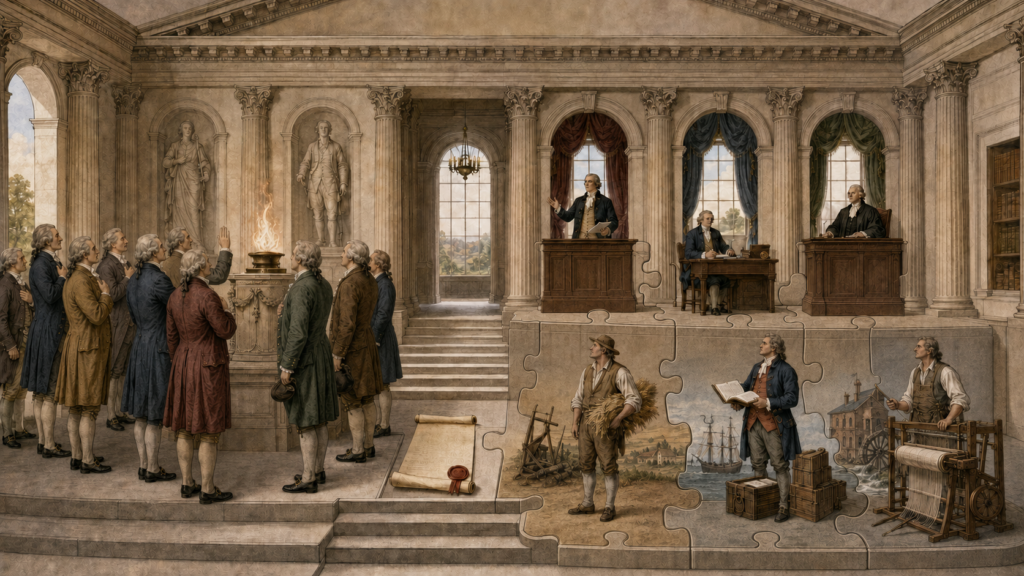
American independence and the adoption of the federal Constitution constitute two successive and distinct moments in the birth of the United States. From the resolutions of the First Continental Congress in 1774, through the Declaration of Independence in 1776, to the Constitution of 1787, the objective shifted: the revolutionaries initially justified the colonies’ emancipation from British rule in the name of natural equality, consent and resistance to tyranny; the delegates to the Constitutional Convention subsequently sought to establish a national government capable of safeguarding liberty, security and the union of the states over the long term. By reaffirming popular sovereignty and the principle of liberty, the Constitution carries independence forward. Yet the two moments exhibit different orientations: the revolutionary phase fosters the democratic assertion of rights and distrust of power, while the constitutional phase gives priority to representation, the selection of those who govern and mutual checks among governing powers.
To understand this shift, it must be situated within the transformations of English political thought during the 17th and 18th centuries. Natural equality, self-preservation, consent, property, the opposition between power and liberty, as well as the coordination of interests through commerce or constitutional design, provide Americans with the conceptual building blocks of their political order. Political divisions between Whigs and Tories and between Court and Country, along with tensions between mercantilist and liberal approaches, also permeate debates across the Atlantic. The American Revolution therefore does not represent a break with English political culture: it adopts principles and incorporates tensions that had developed within it.
Thus, the divisions between Federalists and Anti-Federalists, and subsequently between Federalists and Republicans, intersect with—but do not exhaust—the tensions between democracy and elitism, republicanism and aristocratic government, agriculture and commerce, and virtue and interests. The ideal of an agrarian republic remains powerful for Jefferson and the Republicans, whereas Hamilton’s project seeks to diversify the economy by combining agriculture, commerce, manufacturing and finance within the framework of a strong national government. The actors thus differ over the institutions, economic activities and forms of power capable of securing the liberty and prosperity of the young Republic.
The debates foreground two complementary modes of regulating interests. The first, economic, rests on commerce: exchange is expected to bring private interests into harmony, promote prosperity and replace war with peaceful competition. The second mode of regulation is political. In The Federalist Papers, representation, the Republic’s geographical extent, the separation of powers and institutional checks are intended to contain the effects of factions without abolishing the liberty that gives rise to them. Within this political framework, virtue disappears neither from the actors’ discourse nor from their aspirations, but it gradually becomes secondary to the economic and constitutional mechanisms that organise the interplay of interests.
Some Foundational Conceptions in English Political Thought
Hobbes
From antiquity onwards, Stoic philosophies had conceived of forms of natural equality with respect to reasoning and the ability to discern the good.1 Christianity, for its part, drew no particular distinction with regard to salvation: men and women had been created in the image of God, and all inherited original sin.
In the 17th century, Hobbes describes an anti-aristocratic state of nature in which men possess equal faculties of body and mind, so that “the weakest has strength enough to kill the strongest, either by secret machination, or by confederacy with others, that are in the same danger with himself”.2 Natural equality gives rise to an “equality of hope in the attaining of our ends”. Thus, if two people desire the same thing, which they cannot both possess, they become enemies and, for the sake of their own preservation or enjoyment, “endeavour to destroy, or subdue one another”.3
To these assumptions, already marked by conflict, Hobbes adds an insatiable desire for power, the displeasure of social life in the absence of a power capable of keeping men in awe, and the pursuit of glory, through which each seeks to demonstrate the superiority of his own worth. Taken together, these culminate in a generalised war, reminiscent of the English Civil War, during which political authority had collapsed. Men extricate themselves from this anarchic and agonistic state by submitting to a sovereign political authority because they fear death, aspire to a comfortable life and make use of their reason. Reason enjoins them to pursue self-preservation.
Hobbes’s state of nature marks a profound philosophical break with earlier philosophies insofar as it establishes equality and self-interest as the theoretical premises of political constructions that aspire to scientific status. Through the contract, equality leads to submission to a sovereign rather than to government by the people. In the absence of a sovereign and under the rule of self-interest, equality produces endless competition.
Pufendorf and Locke
Contemporaries of Hobbes, Pufendorf and Locke criticise his agonistic premises. They each attribute to reason, which gives expression to the law of nature, the capacity to coordinate behaviour in the state of nature, prevent wars and promote peace. Nevertheless, in keeping with Hobbes, their respective anthropologies are grounded in equality and self-preservation.4
In material terms, whereas Hobbes is primarily concerned with security, Pufendorf5 and Locke6 both assign a major role to the economy. According to the former, men leave the state of nature through innovations and organisations that transform their lives. The latter, following Hooker, argues that men form societies because “we are not by ourselves sufficient to furnish ourselves with competent store of things, needful for such a life as our nature doth desire”.7 Locke thereby places particular value on property, money and labour.8 He conceives of liberty and equality in relation to law, which takes precedence over virtue.9 According to him, when individuals form a civil society, they surrender their natural power; in return, laws enacted by the legislature have authority only to the extent that the legislature was itself established by consent.
With Pufendorf and Locke, the transition from the state of nature to the civil state is achieved in part through economic development, which rests on a natural tendency towards self-preservation and the satisfaction of desires—that is, self-interest.
Montesquieu, Hume and Smith
Montesquieu, Hume and Smith develop the philosophy of interests in two complementary directions:
- A constitutional arrangement—the separation of powers—that channels the interplay of interests.10
- The free-market mechanism, based on commerce, which harmonises interests.11
All three philosophers emphasise the capacity of commerce to generate wealth for all participating countries—the free market enables every partner to grow. They advocate a transition from a state of generalised warfare to one of generalised economic competition, perceived in the 18th century as “peaceful”.
Power and Liberty
In 18th-century England, the radical Whigs, as Gordon Wood calls them,12 carry forward the Country tradition in opposition to the Court.13 Power denotes political domination by a single ruler, whereas liberty denotes popular sovereignty. This opposition reflects the recurrent conflict between the king and the House of Commons, which represents the people. Despite the balance sought by the English constitution, political history shows that rulers have too often undermined the welfare of the people and that the people have too often been compelled to place their power in the rulers’ hands.
According to the radical Whigs, politics amounts to the acquisition of power. “The love of power is natural,” James Burgh asserts, quoting Bolingbroke, “is insatiable; it is whetted, not cloyed, by possession.”14 The Whigs are obsessed with this intoxicating desire for domination.
Thomas Gordon’s anthropology in Cato’s Letters appears remarkably close to Hobbes’s. Letter 40 argues that every man loves himself more than humanity as a whole, that laws and force protect us from one another, and that treaties are upheld by fear, power and interest.15 Trenchard and Gordon, the authors of these essays, are familiar with Hobbes’s work: they cite him in Cato’s Letters and discuss Leviathan in The Independent Whig.16
Although the anthropology of the radical Whigs resembles Hobbes’s, their conclusions differ radically from his. For the radical Whigs, since magistrates are subject to the same passions as everyone else—and political office affords them exceptional means of satisfying those passions—government is a trust delegated to rulers and must be subject to stringent constraints.17
The Whig articulation of power and liberty is not confined to simple opposition: Trenchard defines liberty as an individual’s power over his own actions and enjoyment of the fruits of his labour.18 Montesquieu, who was probably drawing on Bolingbroke19 when he asserted that “every man invested with power is apt to abuse it”,20 elsewhere also connects power and liberty: “liberty can consist only in the power of doing what we ought to will”.21 In both cases, power is associated with a measure of restraint or rational self-mastery. Excessive power, because it encroaches upon the liberty of others, becomes antithetical to the very idea of liberty.
American Independence, Then the Constitution
Independence
The American colonists read and make extensive use of the writings of Locke, Montesquieu and the Scottish Enlightenment.22 They are steeped in—and identify with—English culture, particularly its political culture.23 The Declaration and Resolves of the First Continental Congress of 1774 employ wording virtually identical to Locke’s: the colonists “are entitled to life, liberty and property” and “have never ceded to any sovereign power whatever, a right to dispose of either without their consent”.24 In this document, they claim the rights of “free and natural-born subjects, within the realm of England”. According to them, English liberty, and that of all free government, rests on “a right in the people to participate in their legislative council”, which presupposes representation they currently lack in the British Parliament. They also assert their entitlement to the common law, colonial statutes and the “independence” of the branches of government guaranteed by the “English constitution”.
As late as July 1775, the Second Continental Congress submits a petition to George III in which the colonists describe themselves as his “faithful subjects”, implicitly asking for his protection against parliamentary and ministerial measures. The King’s August Proclamation for Suppressing Rebellion and Sedition puts an end to the hopes of reconciliation maintained until then. Only from this point does the King himself become a tyrant in the colonists’ eyes, because he now appears officially aligned with Parliament.
On 10 January 1776, Thomas Paine publishes the pamphlet Common Sense, in which he criticises British rule and argues for independence.25 From the outset, the author distrusts governments in general: whereas society positively promotes happiness, government does so negatively by restraining vice; it is a “necessary evil” that can become intolerable when it inflicts suffering, especially since the people furnish the state with the means of repressing them. Every government originates in virtue’s inability to establish lasting liberty and security.
Paine then targets the English constitution while acknowledging its aura: “I know it is difficult to get over local or long-standing prejudices, yet if we will suffer ourselves to examine the component parts of the English constitution, we shall find them to be the base remains of two ancient tyrannies, compounded with some new republican materials.” The King and the House of Lords embody the tyrannical elements; the House of Commons, the republican element. The fundamental problem is that, contrary to prevailing political assumptions, the House of Commons fails to counterbalance monarchical and aristocratic power. Since the Crown holds the upper hand, “we have been foolish enough to put the Crown in possession of the key”.
Beyond this institutional imbalance, Paine argues that Great Britain acts towards the American colonies out of “interest not attachment”. Rather than supporting imperial wars, the colonies can emancipate themselves through commerce—“Our plan is commerce”—which “will secure us the peace and friendship of all Europe; because it is the interest of all Europe to have America a free port. Her trade will always be a protection”. Although war may bring a decline in trade and the formation of an army, the demands of armed conflict in turn generate new markets. Paine presents the building of a fleet as “an article of commerce”, since it is “the natural manufactory of this country”.
A little further on, he argues that independence should be declared as quickly as possible. The colonies, he believes, have the advantage of a population that is still small and vast tracts of “unoccupied” land, which would lighten the burden of debt. Population growth, by contrast, would weigh on unity, particularly because commerce “diminishes the spirit both of patriotism and military defence”. Moreover, history teaches that the bravest deeds have always been accomplished while nations were still in their infancy.
How can the tensions in Paine’s argument about commerce be reconciled? We shall return to this question in Part Three. As regards independence, Common Sense, which meets with resounding success upon publication, illuminates the shift taking place in the colonists’ minds while bringing philosophical and political principles and orientations to the fore. Nearly six months after its publication, the Declaration of Independence, drafted by Jefferson, attributes to the King a “long train of abuses”, including decisions made by Parliament. The universal principles set out in the preamble justify the right to dissolve the English colonial government, regarded as illegitimate and tyrannical. They express the egalitarian convictions animating the governments of the newly independent states.
According to Wood,26 the Revolution “greatly democratized” the new republican state legislatures by increasing the number of their members and broadening their electorates. In the 1780s, elections often lead to the replacement of more than half of the representatives. Public galleries are installed in legislative chambers and sessions are opened to the public, while a growing number of newspapers, including daily papers, begin reporting on legislative debates.
The Constitution
By opening with “We the People”, the United States Constitution of 1787 reaffirms the principle of popular sovereignty. Its objectives of union, justice, domestic tranquillity, common defence, general welfare and securing liberty carry independence forward while placing greater emphasis on security. Whereas the Declaration of Independence sought to justify the colonies’ emancipation, the Constitution aims to create a federal state capable of preserving their newly acquired autonomy and coordinating the states with one another more effectively than the Articles of Confederation had done.27
The Philadelphia Constitutional Convention gives rise to the division between Federalists, who support ratification of the new Constitution, and Anti-Federalists. The latter fear the potential threat that a central authority poses to the liberty of citizens and states. American historians, particularly Jensen and Bailyn, have emphasised the remarkable ideological continuity between the revolutionaries and the Anti-Federalists.28
The ratification of the Constitution by the different states provides the occasion for an extensive national debate, conducted notably through essays published in newspapers. Three Federalists—James Madison, Alexander Hamilton and John Jay—write a series of texts that sheds light on their motivations.29 These documents are of particular interest because Madison and Hamilton are traditionally regarded as two of the leading contributors to the constitutional debates.30
Let us examine Federalist No. 10 in detail, since it offers a remarkable synthesis of the problem of regulating interests through representation and of the philosophical foundations on which the constitutional solution rests. Madison opens with a warning against the dangerous vices of popular government: everywhere, virtuous citizens complain of governmental instability, disregard for the public good in conflicts between rival parties, and the adoption of measures not according to justice and the rights of minorities, but through the superior force of an interested and overbearing majority.
There are two ways of curing the mischiefs of faction—those interest groups opposed to the common interest: either by removing their causes or by controlling their effects. The first remedy proves worse than the disease, since it requires either suppressing liberty or imposing the same opinions, passions and interests on everyone. The diversity of human faculties, from which the right to property arises, is, like liberty, a formidable obstacle to making interests uniform. Yet the first object of government is to protect these faculties, whose unequal development leads to the unequal distribution of property. The sentiments that different forms of property arouse in their owners naturally divide society into different interests and parties: landed, manufacturing, mercantile and moneyed interests, together with many lesser interests. The regulation of these economic interests constitutes the principal task of modern legislation.
How are interests to be balanced? In Madison’s view, it is futile simply to rely on the interplay of parties, since the most powerful factions will come to dominate. It seems equally futile to hope that a few enlightened minds might reconcile conflicting interests with the common good. Since the causes of faction cannot be removed, only their effects can be controlled, which republican representation—a mechanism built into the Constitution—promises to do.
Here Madison draws a traditional distinction between small and large republics.31 The number of representatives must be large enough to guard against the cabals of the few and sufficiently limited to avoid the confusion of the multitude. Since representatives are proportionally more numerous in small republics, it follows that, provided the proportion of suitable candidates is no lower in large republics than in small ones, large republics offer a greater probability of a suitable choice. Moreover, because the electorate is larger and voting is freer, it is more likely to elect men whose views are the most enlightened, whose sentiments are the most virtuous, whose merit is most likely to attract votes and whose reputations are the most firmly established.
Another crucial advantage of large republics is that they reduce the danger posed by factions: the more the republic expands in population and territory, the more interests diversify and the less likely a tyranny of the majority becomes.32
Representation alone is not sufficient to secure liberty. The separation and balancing of powers also play a crucial role. They concern, on the one hand, relations between the federal government and the states and, on the other, interactions among the different branches of the federal government. In both cases, they must be understood in the light of Madison’s conception of representation: the primary objective is to limit popular excesses, whether they arise in state legislatures or in the directly elected House of Representatives.33
In Federalist No. 51, Madison develops the idea that the separation of powers is secured by the internal structure of government—that is, by the relationships among its different departments. Each department must have a will of its own; consequently, its members should be neither appointed nor remunerated by another department. All appointments must nevertheless be drawn from the same source—the people—through channels that do not communicate with one another. An exception is allowed for the judiciary because of the particular qualifications required for such offices and the permanence of tenure, which is expected to eliminate any sense of dependence.34
In a republican government, according to Madison, the legislative branch necessarily predominates. The remedy for this imbalance consists in dividing the legislature into separate chambers and making them, through different modes of election and different principles of action, as little connected as possible. The weakness of the executive may, in turn, be offset by an “absolute negative”, although this may prove insufficient if not exercised with the requisite firmness, or dangerous if abused.
Conflicting Orientations
Federalists vs Republicans
Whereas the independence phase foregrounds natural rights—liberty and equality in particular—and rejects the tyranny of the English government, the constitutional phase seeks to construct a national authority whose structure resembles that of the English government: a Congress consisting of two representative chambers and a strong executive with a veto that can be overridden only by a two-thirds majority in both chambers. The members of the Constitutional Convention nevertheless take care to limit each of these powers and to confer popular legitimacy upon them, directly or indirectly, through the principle of majority voting. In this regard, although Madison is concerned about the tyranny of the majority, he does not question the majority principle in elections, since he believes that the diversity of interests limits the danger.35
Despite the intended continuity between the two phases, the independence phase is driven more by liberty and equality, whereas the constitutional phase emphasises security and a meritocratic form of political control that may be described as elitist. Although figures such as Washington, Jefferson, Adams and Hamilton stand apart from the English or French nobility, they nevertheless regard themselves, in Jefferson’s words, as “natural aristocrats”.36 They defend equality while recognising differences in education and ability that justify hierarchies. In 1787, Benjamin Rush expresses a widely shared view when he says that natural rights “require no learning to unfold them. They are better felt, than explained”. Accordingly, mechanics and philosophers, farmers and scholars stand on an equal footing in matters of liberty. Government, however, is “a complicated science” requiring abilities and knowledge of a variety of other subjects.37
The tension between the two phases, already apparent in the debates between Federalists and Anti-Federalists, continues during the first administrations through the opposition between Federalists and Republicans. The former, particularly under the influence of Hamilton, who served as Secretary of the Treasury during both of Washington’s terms, implement a policy with distinctly British overtones: the consolidation of the states’ war debts and their transformation into a permanent national debt; the establishment of a national bank; the imposition of tariffs in a mercantilist vein; and, above all, the development of a strong executive, a shift facilitated by Washington’s authority. Hamilton’s and the other Federalists’ political ideal was not Madison’s “disinterested adjudicatory state” but “an illustrious, European-type state” capable of rivalling the great European powers.38
At the outset of the First Congress, in which he sat in the House of Representatives, Madison remained a “fervent nationalist”, eager to secure an independent source of revenue for the new government, establish the executive departments and ensure the ascendancy of Federalist ideas. Differences with Hamilton, however, soon emerged. As a representative of Virginia, Madison wished to distinguish the original holders of Treasury securities from their current holders, since rumours were circulating that Northern speculators were buying up state bonds for a fraction of their face value. More troubling still was the establishment of a national bank: the agrarian South regarded bank-created money as unreal and believed that it benefited Northern speculators exclusively. Beyond Virginia, there was a widespread sense that the bank represented another step towards the creation of an English-style government.39
The emerging divide pitted the interests of the rural world—particularly the slaveholding South—against those of international trade and finance in the North-East. By early 1791, Jefferson was worried about the “heresies” being advanced in the press and began urging friends to support the agricultural interest and pure “republicanism” against the “stock-jobbers” in Congress. Madison went so far as to describe the supporters of Hamilton’s programme as “Tories” (the pro-aristocratic party in England), a fierce accusation in the immediate aftermath of the Revolution. These initially private comments soon entered public debate, as Jefferson and Madison assumed the leadership of the Republican “party”—not yet a party in the modern sense, but rather a political orientation. As we have seen, factions were feared as sources of unrest and, when they became majorities, as threats of tyranny. This sentiment was widespread in the young American republic.40
Interests versus Virtue
Alongside the disagreements between Federalists and Republicans lies a tension between two further orientations: the first is republican virtue, to which both parties lay claim; the second consists in accepting the interplay of interests and setting them against one another so as to balance them.
The colonists, and later the Americans, are confident in their ability to overcome the difficulties traditionally faced by republics—factions, inequalities and corruption. This confidence derives in particular from European Enlightenment thought, which fashioned an image of a New World standing in sharp contrast to an Old World mired in feudalism, luxury and artifice. The New World appears to them free from social distinctions and stratification, exceptionally egalitarian, young, rustic, energetic and sometimes uncouth, yet devoid of the Old World’s endemic corruption.41 Catharine Macaulay, for example, believes that the United States, still little urbanised, has not yet developed an addiction to commerce and luxury. Until the 1780s, she hopes that the American Revolution will enable the English to recover “our almost lost liberties”.42 By 1790, she has come to fear that the young Republic might lose its virtue and attachment to liberty as commerce expands.43
Macaulay primarily associates commerce with luxury and corruption, whereas Montesquieu, Hume and Smith regard it first and foremost as a form of peaceful competition, preferable to warfare and not devoid of virtue.44 They argue in favour of economic liberalism, through which nations enrich one another.45 By the end of the eighteenth century, a mercantilist approach to commerce can be distinguished from a liberal one. The former is promoted in the United States by Hamilton and the Federalists from 1789 onwards; the latter inspires the revolutionaries and the Republicans. Common Sense contains a tension between these two approaches: following a mercantilist logic, Paine explicitly links foreign trade to independence and the creation of a navy. At the same time, he defends free access to American ports and presents commerce as a force for peace.
Liberalism proposes a model in which interests naturally harmonise with one another—Smith’s famous invisible hand. In the United States, it is supported first by the revolutionaries and later by the Republicans, particularly by the emerging middle class.46 Liberal sociability presupposes that human beings possess a natural moral sense, sympathy and the capacity to adjust to one another through social interaction. Whereas virtue in the republican tradition requires forms of sacrifice for the common good, the liberal conception alters its moral foundations: virtue loses its austere, martial and cultivated character—acquired through education—and becomes a natural disposition.
Alongside this liberal model stands constitutional architecture. In a previous article, we saw that Montesquieu’s philosophy—particularly the separation of powers—entailed the promotion of the interplay of interests and a devaluation of virtue.47 Influenced by Montesquieu, the Americans devise institutions, laws and policies—whether Federalist or Republican—that give concrete form to a shift whereby political equilibrium increasingly rests on the interplay of interests rather than on virtue, even though virtue still appears central to the actors themselves. The Federalist Papers Nos. 10 and 51, examined above, illustrate this point particularly clearly.
Inspired by the European philosophies of the seventeenth and eighteenth centuries, the American Revolution gives rise to a democratic hope underpinned by the concepts of equality, consent and legitimate power. At the same time, liberalism offers a peaceful solution to conflict through the natural coordination of interests. A decade later, the Constitution proposes another form of regulation of interests—a political one—through representation, the separation of powers and various institutional checks. By the end of this sequence of events and institutional developments, virtue appears in a new light: compatible with prosperity, refinement, economic competition and national development. This reconfiguration of virtue forms the common backdrop to the conflict between the Jeffersonian ideal of an agrarian republic and the Hamiltonian project of a diversified economy combining agriculture, commerce, manufacturing and finance, backed by a strong national government. Indeed, both Republicans and Federalists attach increasing political importance to economic interests and their regulation, even though the modes of regulation differ between the two parties. Virtue does not disappear; it becomes secondary to the mechanisms through which interests interact.
Notes
1 Long et Sedley, Les philosophes hellénistiques II, Flammarion, 2001, p. 413.
2 Hobbes, Leviathan (1651), ch. 13. Project Gutenberg e-text, accessed 4 August 2026. https://www.gutenberg.org/files/3207/3207-h/3207-h.htm
3 Ibid.
4 Samuel von Pufendorf, Le droit de la nature et des gens, Amsterdam : Chez la veuve de Pierre de Coup, 1734, p. 174 : natural rights are grounded in “the predominant inclination of all animals, which irresistibly impels them to seek every conceivable means of self-preservation”, and in independence. Because, in the state of nature, each person conceives of themselves as independent of all authority, each “is regarded as equal to every other”.
John Locke, Two Treatises of Government, in The Works of John Locke in Nine Volumes, vol. 4: Economic Writings and Two Treatises of Government, London, Rivington, 1824 (12th ed.), Bk II, §6: “The state of nature has a law of nature to govern it, which obliges every one: and reason, which is that law, teaches all mankind, who will but consult it, that being all equal and independent, no one ought to harm another in his life, health, liberty, or possessions . . . Every one, as he is bound to preserve himself, and not to quit his station wilfully, so by the like reason, when his own preservation comes not in competition, ought he, as much as he can, to preserve the rest of mankind”.
5 https://damiengimenez.fr/wpdgi_article_en/interests-as-the-driving-forces-of-social-recomposition-in-eighteenth-century-great-britain/#Pufendorf_a_natural_and_commercial_sociability
6 https://damiengimenez.fr/wpdgi_article_en/wealth-as-a-political-principle-england-17th-18th-centuries/#Locke_property_as_the_political_language_of_wealth
7 John Locke, op. cit., §15.
8 https://damiengimenez.fr/wpdgi_article_en/wealth-as-a-political-principle-england-17th-18th-centuries/#Locke_property_as_the_political_language_of_wealth
9 https://damiengimenez.fr/wpdgi_article_en/modern-conceptions-and-practices-of-political-liberty-and-equality/#Locke_and_Montesquieu_Juridical_Liberty_and_Equality
10 https://damiengimenez.fr/wpdgi_article_en/how-interests-and-values-rose-and-virtue-declined-16th-18th-centuries/
11 https://damiengimenez.fr/wpdgi_article_en/interests-as-the-driving-forces-of-social-recomposition-in-eighteenth-century-great-britain/#Smith_the_harmony_of_interests
12 Gordon S. Wood, The Creation of the American Republic, 1776-1787, Norton, 1972, p. 19 sq.
13 https://damiengimenez.fr/wpdgi_article_en/interests-as-the-driving-forces-of-social-recomposition-in-eighteenth-century-great-britain/#Court_vs_Country
14 Gordon S. Wood, The Creation of the American Republic, 1776-1787, op. cit.
15 https://en.wikisource.org/wiki/Cato%27s_Letters/Letter_40
16 Annie Mitchell. “A Liberal Republican ‘Cato’”, American Journal of Political Science, 48, no. 3 (2004): 588–603. https://doi.org/10.2307/1519918.
17 https://press-pubs.uchicago.edu/founders/documents/v1ch2s2.html
18 https://press-pubs.uchicago.edu/founders/documents/v1ch17s8.html
19 Albert O. Hirschman, Les passions et les intérêts, 2020 (1977), p. 72.
20 Montesquieu, The Spirit of Laws, XI, IV in The Complete Works of M. de Montesquieu (London: T. Evans, 1777), 4 vols. Vol. 1.
21 Ibid., XI, III.
22 Gordon S. Wood, The Creation of the American Republic, 1776-1787, op. cit., p. 8, 14, 29, 119, 153, 160.
23 We have already highlighted this point in the previous article: https://damiengimenez.fr/wpdgi_article_en/modern-conceptions-and-practices-of-political-liberty-and-equality/#Continuities_and_Ruptures_in_the_American_Revolution
24 Declaration and Resolves of the First Continental Congress, October 14, 1774, URL: https://avalon.law.yale.edu/18th_century/resolves.asp
25 https://oll.libertyfund.org/pages/1776-paine-common-sense-pamphlet
26 Gordon S. Wood, Empire of Liberty, Oxford University Press, 2009, chapter 1.
27 Jack N. Rakove, Original Meanings: Politics and Ideas in the Making of the Constitution, Vintage Books, 1996.
28 Max M. Edling, A Revolution in Favor of Government, Oxford University Press, 2003, chapter 2.
29 The Federalist Papers: https://guides.loc.gov/federalist-papers/full-text
30 Jack N. Rakove, op. cit.
31 Many authors consider the republican model applicable only to small states. Montesquieu notes, however, that confederations possess “all the internal advantages of a republican, together with the external force of a monarchical government”. Montesquieu, op. cit., IX, I. In Federalist No. 9, Hamilton explicitly invokes this aspect of Montesquieu’s theory, quoting him at length, to justify the application of republican concepts to the thirteen colonies.
32 Although the phrase “tyranny of the majority” appears to have been first used by John Adams in his A Defence of the Constitutions of Government of the United States of America in 1788, Madison was probably, of all Anglo-American republicans, the one who “thought longest and hardest about the problem of the tyranny of the majority”: Annelien de Dijn, “Republicanism and Democracy: The Tyranny of the Majority in Eighteenth-Century Political Debate” in Yiftah Elazar and Geneviève Rousselière (eds.), Republicanism and the Future of Democracy, Cambridge University Press, 2019, p. 59–74.
33 Jack N. Rakove, op. cit., chapter 3.
34 Recurring contemporary criticisms of the Supreme Court show how unjustified these exceptions were and how heavily they weigh on the political process.
35 He reiterates this conviction in Federalist No. 51: while all authority in the federal government “will be derived from and dependent on the society, the society itself will be broken into so many parts, interests, and classes of citizens, that the rights of individuals, or of the minority, will be in little danger from interested combinations of the majority.”
36 Gordon S. Wood, Empire of Liberty, op. cit.
37 Quoted by Gordon S. Wood, Ibid.
38 Ibid.
39 Ibid.
40 Ibid.
41 Gordon S. Wood, The Creation of the American Republic, 1776-1787, op. cit., p. 97.
42 Richard Whatmore, The End of Enlightenment: Empire, Commerce, Crisis, Penguin Books, 2024, p. 120.
43 Ibid., p. 123.
44 Montesquieu, The Spirit of Laws, op. cit., V, VI: “The spirit of commerce is naturally attended with that of frugality, economy, moderation, labour, prudence, tranquillity, order, and rule.”
45 Ibid., XX, II ; Adam Smith, An Inquiry into the Nature and Causes of the Wealth of Nations [1776], Project Gutenberg eBook no. 3300, released 1 June 2002, last updated 3 July 2025, https://www.gutenberg.org/ebooks/3300 (accessed 28 July 2026) ; David Hume, “Jealousy of Trade”, Essays: Moral, Political and Literary, Liberty Fund, Inc., 1987.
46 Gordon S. Wood, Empire of Liberty, op. cit.; Joyce Appleby, Liberalism and Republicanism in the Historical Imagination, Harvard University Press, 1992.
47 https://damiengimenez.fr/wpdgi_article_en/how-interests-and-values-rose-and-virtue-declined-16th-18th-centuries/