Is the economy a driving force behind democracy or its gravedigger? – Article 2
Political liberty and equality are the two cardinal principles of contemporary democracies. Their meaning may seem familiar, yet it is far from self-evident. Liberty may refer, among other things, to independence from domination, protection against arbitrary power, participation in collective government, the freedom to move and exchange, or autonomy within relations of interdependence. Equality may likewise concern the subjection of all to the same law, access to political citizenship, or the social guarantees that make autonomy effective. These conceptions often complement one another, but they may also come into tension.
The previous article in this series on the relationship between economy and democracy ranged from Antiquity to the British colonies in America in order to examine the conditions under which commerce accompanies restricted forms of political equality. It concluded that this causal relationship is conditional: exchange does not naturally produce equality, since its effects depend on the form of government and the ideals that sustain it; the age, stability and degree of openness of the social hierarchy; the relationship between commerce, war and taxation; and the balance of power between social groups. The present article resumes the enquiry at the dawn of the modern revolutions. It nevertheless shifts the focus: the question is no longer merely how commerce influences equality, but how political liberty and equality take shape together.
The aim is neither to offer a single definition of these principles nor to trace an exhaustive history of them. Rather, it is to identify several ideal types arising from philosophical conceptions, practices of government, and economic and social transformations. Landed property, colonial experiences of self-government, law and constitutions, commerce, money, the American and French Revolutions, industrialisation, wage labour and social rights all alter the foundations of liberty and the boundaries of the circle of equals. This approach makes it possible, in particular, to understand how universalist principles can coexist with political exclusion, slavery, colonisation and profound economic asymmetries. It also helps to determine the conditions under which the economy supports democracy, and the point at which it begins to threaten its principles.
We shall first examine the matrix formed during the 17th and 18th centuries: Harrington’s agrarian republic, the democratic practices of the American colonies, and the juridical conceptions developed by Locke and Montesquieu. We shall then highlight the ambiguities of the American and French Revolutions, poised between the universalisation of rights, imperial continuities and an attempt at virtuous regeneration. The third part will consider the transformations of the 19th century: the liberty of the Moderns according to Constant, the transition from independence founded on land to autonomy within interdependence, and the gradual extension of suffrage. Finally, we shall bring these legacies together within an analytical framework in order to reveal their complementarities, their oppositions and the vulnerabilities they leave unresolved.
The Matrix of the 17th and 18th Centuries
Republican Liberty and Equality, Rooted in Landed Property
In 17th-century England, most opponents of royal absolutism drew on an idealised version of what they called the Ancient Constitution.1 They emphasised the diversity of the English constitution’s written and unwritten sources, and their accumulation over the course of history. Thus, on the eve of the Glorious Revolution, Algernon Sidney rejected Robert Filmer’s hypothesis – Filmer being a theorist of a strong, patriarchal form of royal power – that the earliest English parliaments dated back to Henry III. According to Sidney, parliaments were as ancient as the nation, and there had been no period without “such councils or assemblies of the people as had the power of the whole”, making and unmaking laws as they pleased.2 The origins of the English Parliament remain a matter of debate. The UK Parliament describes Simon de Montfort’s Parliament of 1265 as the first occasion on which representatives from towns and counties were summoned together to discuss matters of national concern.3 The Whigs thus promoted a retrospective interpretation of the English constitution, based on medieval fragments reinterpreted in the light of the political conflicts of the 17th century.
Harrington did not subscribe to this interpretation. Instead, he saw medieval common law as reflecting a struggle of interests between the king and the nobility. Rather than drawing on an idealised Saxon national past, he took inspiration from the republican tradition that emerged from the Italian cities of the Renaissance, particularly from Machiavelli, who took the Roman Republic as his model.4 He distinguished between two major forms of government: the “ancient prudence” of the Roman Republic and the “modern prudence” introduced by the barbarians after the fall of Rome. Whereas ancient prudence sought a just distribution of wealth, modern prudence essentially benefited the aristocracy. From this perspective, Harrington proposed a republic founded on an equitable distribution of land, designed to guard against the emergence of aristocracy and domination.5 Beyond its economic foundations, Harrington’s republic was structured around three powers: the Senate, the people and the executive, whose offices rotated through elections held by secret ballot.
The constitution envisaged by Harrington reflects the importance of landed property in the 17th and 18th centuries. In the English Court–Country debate (1690–1740), Country supporters elevated civic virtue and the independence of property owners into fundamental principles. They suspected that debt, the monied interests, public offices and the standing army fostered systemic corruption – at the risk of subordinating Parliament to the Court.6
Across the Atlantic, Harrington exerted a particularly strong influence on Thomas Jefferson7 and, more broadly, on part of the American republican imagination. In the nascent United States, political liberty remained closely associated with the material independence of the landowner: by owning land, he depended on neither an employer, a lord nor a Court; he could participate in the government of the community without being exposed to corruption.8 This conception gave equality a precise but limited meaning: it did not yet denote the universal equality of individuals, but a balance among property-owning citizens, deemed capable of exercising political judgement. Land policies pursued in the western territories extended this matrix by organising settlers’ access to land, while also revealing its exclusionary face: this liberty of property owners was built at the expense of Indigenous peoples and remained largely closed to women, enslaved people and non-property-owners. The democratic experiments of the American colonies unfolded within this tension – between the diffusion of participatory practices and the restriction of the circle of equals.
Democratic Practices in the American Colonies
Conditions of government varied considerably from one colony to another. Some were governed directly by the Crown, while others were controlled by private proprietors or operated under charters regulating relations between the colonists and royal power. Yet distance from London, local administrative needs and the dispersed pattern of settlement fostered forms of self-government throughout the colonies. Although the king and Parliament remained at the centre of the Empire, the colonists managed part of their own affairs: they elected representatives, debated taxation, defended local privileges and resisted the decisions of governors.9
These practices did not, in the first instance, draw upon Athens or the ancient republics. They developed pragmatically within colonial assemblies, New England town meetings, juries, militias, petitions, newspapers, taverns and, later, committees of correspondence. Political participation was therefore less an established doctrine than a collection of habits. The colonists learnt to speak, deliberate, elect, protest, scrutinise and coordinate. When tensions with the Crown intensified, these local practices already provided the instruments for collective mobilisation.10
This democratisation nevertheless remained narrow. The active citizen was generally a free, white man of age who owned property or paid taxes. Rules varied among the colonies, but colonial suffrage rested largely on the idea that only a man possessing stable property had the independence required to judge the common good. Women, men without property, indentured servants, enslaved Africans and most free Black people were excluded, although local exceptions existed. The political equality taking shape in the colonies was therefore real for some free men, but it did not correspond to the universal equality that the modern revolutions would eventually proclaim.11
This restriction of the political body was combined with the colonisation already under way. The relative equality among colonists rested partly on access to land, but that land was not empty. It was seized, purchased under duress, contested or wrested from Indigenous peoples, who resisted European expansion while suffering from disease, warfare, unequal treaties and the constant pressure of settlement. The colonists’ political autonomy did not therefore develop outside British imperialism: it was also a product of it, since the Empire protected, organised and legitimised colonial expansion.12
The American colonies thus demonstrate the historical compatibility of liberty, equality and colonialism. Liberty was that of British subjects in America resisting encroachments by imperial power; equality was that of free men within a restricted political body; and colonisation defined, beyond that body, those who could be displaced, dominated or exploited. The contradiction became apparent only when the principles of liberty and equality began to be formulated as universal rights.
Locke and Montesquieu: Juridical Liberty and Equality
Let us cross the Atlantic once more to consider Locke’s political thought, which marks a major turning point in conceptions of liberty and equality. In his Second Treatise of Government, Locke draws the classical distinction between a state of nature and a civil state. The state of nature allows liberty and equality to be established as natural principles, with liberty remaining within the “bounds of the law of nature”,13 which Locke identifies with reason.14 Unlike Hobbes’s state of nature, characterised by insecurity and the absence of a common power capable of enforcing peace, Locke’s already includes certain limits and obligations that circumscribe liberty. Human beings therefore have no right to destroy themselves or to harm others; they must “make the best and noblest use of their liberty that their own preservation requires of them”.15 Equality, for its part, is conceived in terms of the absence of subordination or subjection, everyone in this state enjoying the same advantages and faculties.
The transition to the civil state – that is, to political societies – requires each person to relinquish their natural power and resign it “into the hands of the community”.16 Why would human beings abandon their natural liberty? Because, in doing so, they entrust society with the exercise of this power. Society thereby becomes sovereign and can ensure the enforcement of laws that provide protection and settle disputes.17 Locke remains focused on limiting arbitrary power, especially royal power; he conceives liberty primarily as freedom from subjection to the arbitrary will of another. Law is therefore the cornerstone of his theory: “the end of law is not to abolish or restrain, but to preserve and enlarge freedom. […] Where there is no law, there is no freedom: for liberty is, to be free from restraint and violence from others”.18 Civil equality is understood in terms of subjection to the laws replacing subjection to royal authority.19
Whereas Harrington emphasises the importance of republican institutions and the economic mechanism of land distribution, Locke bases his political thought on law, which takes precedence over virtue. In the beginning, Locke explains, certain virtuous and excellent individuals acquired a measure of pre-eminence over others through their merits. The latter recognised their natural authority and entrusted them, without any particular precautions, with government and the settlement of their disputes. Over time, however, this authority became entrenched and sacralised, while the successors of the first rulers failed to equal the virtue of their forebears. The remedy lies in establishing a “legislative authority” to which everyone is subject.20
Although Montesquieu, like Locke, conceives liberty in relation to law,21 he was able to observe England’s mixed government and draw the following lesson from it: “To prevent the abuse of power, it is necessary that by the very disposition of things power should be a check to power. A government may be so constituted as no man shall be compelled to do things to which the law does not oblige him”.22 In other words, law alone is not sufficient to limit power. It must be supplemented by constitutional arrangements that ensure a balance between powers and place limits upon them.
Ambiguities of the American and French Revolutions
Continuities and Ruptures in the American Revolution
In the British colonies in America, political thinkers drew upon their local experiences of democratic government as well as a vast range of theoretical sources, including Harrington, Locke and Montesquieu.23 They did not focus on any single philosopher; rather, they developed a republican culture that took inspiration from the English constitution while remaining wary of the hierarchies of rank, patronage and dependence inherited from the Old World.24
From Locke, they retained25 the idea that the purpose of political society was to allow people to enjoy their property in safety – that is, “their lives, liberties and estates”, which Locke called by the general name of property.26 Ownership of material goods, particularly land, arose from the labour bestowed upon them: when an individual, possessing a natural right over their own person, removed things from the state of nature through their labour, they legitimately appropriated them, provided that “enough, and as good” was left in common for others.27 As we have seen, upon entering civil society, people relinquished their natural power. In return, laws enacted by the legislative power possessed authority only insofar as that power had been chosen and society had consented to it.28
Property, in the broad sense Locke gave the term, and citizenship were intertwined. Slaves, regarded as captives taken in a just war, had “forfeited their lives, and with it their liberties, and lost their estates”. Since they were “not capable of any property”, they could not form part of civil society.29 In colonial America, property consisted predominantly of land, but also included movable or commercial property. According to Robert Middlekauff, the close association between individual rights, political institutions and property explains the colonists’ sense of injustice when the British Parliament imposed taxes to which they had not consented.30
The colonists did not reject the English Constitution. Its “greatness” lay in its purpose, which everyone understood: the attainment of liberty. As a social value, it ranked second only to the Bible, “above the privileges of this world”.31 The colonists initially rebelled not against the British political system, but against the failure to recognise them as subjects possessing full rights. From 1764 to 1775, despite their growing resentment towards Parliament and the Crown, they sought reconciliation with both. Even after the first clashes of 1775, John Dickinson drafted a final petition to the king while simultaneously preparing, with Jefferson, the Declaration of the Causes and Necessity of Taking Up Arms.32
The United States Declaration of Independence confirmed the rupture with a government described as tyrannical and with an aristocratic, unequal society.33 The Constitution of 1787, by contrast, displayed greater political continuity with the former mother country. This continuity was expressed, first, through the separation of powers and the establishment of a bicameral Congress whose lower chamber was directly elected. It was also manifested in the continuation of territorial expansion, whose management fell to the federal government. Although the colonists had rebelled against their own subordination to imperial power, once independence had been secured they pursued the same logic of colonial expansion at the expense of Indigenous peoples, who were progressively dispossessed and displaced. As noted above, non-universalist conceptions of liberty and equality are compatible with an imperialist policy that generates new forms of exclusion.
Virtuous Regeneration Confronting the Politics of Interests
By placing greater emphasis on universal rights, the French Revolution distinguished itself from its American predecessor from the outset: the 1789 Declaration of the Rights of Man and of the Citizen laid the foundations of a new political system. In 1794, Robespierre asserted that “the French Revolution is the first to have been founded upon the theory of the rights of humanity and upon the principles of justice”.34 Whereas the Bill of Rights took the form of amendments to the United States Constitution, the French Declaration of Rights served as the preamble to the French Constitution of 1791.
The question of rights nevertheless lay at the heart of the debates surrounding the American Revolution and Constitution. In the Declaration of Independence, it took the form of “self-evident” truths, drawing upon a diffuse philosophical background, whereas the French Declaration of Rights sought to define the contours of these great principles more precisely by relating them to the concept of law. By making the central role of law explicit, it reformulated ideas already present in Locke and Montesquieu; by invoking sovereignty as residing in the nation, it adopted a Rousseauian vocabulary. Universality nevertheless encountered certain limits: although the Declaration did not explicitly exclude women from the possession of natural rights,35 since the term “man” could carry a generic meaning, it did not grant them access to full political citizenship. Moreover, only “active” citizens could vote.
Despite these continuing exclusions, the Declaration of Rights defined the moral foundations of the political order yet to be constructed. Going beyond the debates of the 18th century, which deplored the corruption of governments and their lack of virtue, it presented itself as a remedy for these failings.36 Yet although virtue was mentioned in connection with each citizen’s capacity to hold public office, it did not constitute a political principle on the same level as liberty and equality.
In A Veil over Liberty,37 Bernard Manin shows that Montesquieu exerted a far greater influence than Rousseau on the constitutional debates. Rousseau nevertheless bequeathed “to the Revolution the idea of a return to nature and of regeneration. Beyond the degeneration represented by customs and history, it was necessary to return to nature and to first principles”.38 In 1793–1794, the idea of regeneration, which had been present since 1789 and associated with the creation of a new man,39 entailed transforming individuals corrupted by the play of private interests, luxury, old customs and other influences into virtuous citizens. Virtue here consisted in “the love of one’s country and its laws”,40 an expression derived from Montesquieu. Yet, as we have previously shown, this formulation, combined with the constitutional arrangement set out in The Spirit of the Laws – which rests upon the interplay of interests and countervailing powers – relegated virtue to a secondary position.41
Robespierre attempted to reverse this tendency, initially by following Montesquieu to the letter: he established virtue as “the fundamental principle of democratic or popular government […] this sublime sentiment presupposes a preference for the public interest over all private interests”.42 By arguing that “virtue is natural to the people”,43 he proved more optimistic than Montesquieu, who stressed that “political virtue is a renunciation of oneself, which is always a very painful thing”.44 Political virtue had, in particular, to resist the temptations of dishonest enrichment stimulated by the spirit of commerce.45
By proposing, in the context of revolutionary government, to supplement the principle of virtue with the driving force of terror, Robespierre departed more decisively from the author of The Spirit of the Laws, who reserved fear for despotism alone.46 As Manin has shown, however, Montesquieu did not rule out a logic of emergency government, expressed through the metaphor of a “veil over liberty”: “I confess, nevertheless, that the practice of the freest peoples who have ever lived on earth leads me to believe that there are cases in which liberty must, for a moment, be veiled, as the statues of the gods are concealed.”47 According to Manin, all the extraordinary measures of 1793–1794 were justified by means of a similar argument, with the expression “veil over liberty” recurring throughout the revolutionary debates.48
The radicalisation pursued by Robespierre under the aegis of virtue, “without which terror is pernicious”,49 became trapped in the search for enemies, conspirators and traitors to the nation. Moreover, it extended the circle of enemies indefinitely: initially directed against royalists and declared traitors, suspicion gradually reached hostile journalists and then, more broadly, anyone whom the revolutionary government deemed counter-revolutionary. Far from reversing the tendency towards the devaluation of virtue and the valorisation of the economy, the trauma of the Terror probably contributed to it.
The Transformations of the 19th Century
The Liberty of the Moderns
As early as 1796, Benjamin Constant denounced the Effects of the Terror.50 Against those who regarded it as a necessary evil for the Republic, he maintained that authority could have been upheld through justice alone.51 Instead, the Terror “shed the blood of blameless warriors”; it “created tribunals without appeal and without due process, and murdered sixty victims a day without trial”. Far from establishing virtue, it “associated an idea of morality with the most puerile practices and the most futile forms of monarchy”. It was therefore to the Terror that “the decay of public spirit” had to be attributed.52
In his famous lecture The Liberty of the Ancients Compared with That of the Moderns,53 delivered in 1819, Constant casts historical light upon the notions of the public and the private. He contrasts the liberty of the Ancients – collective participation in political deliberations and decisions – with the liberty of the Moderns: being subject to laws rather than arbitrary power, expressing oneself, choosing one’s occupation, disposing of one’s property, moving freely, assembling and exercising influence over politics. Whereas the lives of the Ancients revolved around a political public sphere that left almost no room for individual independence, those of the Moderns are oriented towards “security in private enjoyments”.
The gulf separating these two conceptions is reflected in the activities of their respective civilisations. Confined within narrow boundaries, the ancient republics sought to expand and were constantly at war with one another. The Moderns live in large states and, in the European societies considered by Constant, slavery has disappeared, reducing the leisure available for permanent political participation. They rely more extensively on commerce, “a gentler and surer means of inducing another to consent to what suits one’s own interest”. Moreover, commerce “inspires in men a keen love of individual independence”: it provides for their needs and desires without requiring the intervention of authority. When governments interfere in private affairs, they manage them less effectively and at greater expense than private individuals.
According to Constant, the failure to distinguish between the liberty of the Ancients and that of the Moderns produced grave misunderstandings. By transposing the collective sovereignty of the Ancients to the Moderns, Jean-Jacques Rousseau furnished “fatal pretexts for more than one kind of tyranny”. Inspired in particular by his metaphysics and by Mably’s austerity, the revolutionaries “believed that everything must still yield before the collective will, and that all restrictions upon individual rights would be amply compensated for by participation in social power”.
Although individual liberty constitutes “true modern liberty”, “political liberty is its guarantee” and is therefore indispensable. But how can despotism be prevented when, absorbed in our private affairs, we come to neglect politics? Attachment to individual liberty ensures that it will be defended when attacked. Moreover, commerce makes arbitrary action “easier to evade, because it changes the nature of property”: as movable property, it circulates more readily, creating an “invisible and invincible obstacle” to the action of social power. Financialisation likewise promotes liberty, because money “conceals itself or takes flight; […] private individuals are stronger than political powers in our day; wealth is a power more readily available at every moment, more applicable to every interest, and consequently much more real and more readily obeyed”.
Constant thus grounds the guarantees of political liberty partly in economic mechanisms. In doing so, he contributes to the valorisation of the economy. He does not, however, go so far as to entrust individual liberty blindly to economic processes. Although politics now represents only one sphere of existence among others, it remains essential to modern liberty: the latter requires citizens to participate in the representative system and to “exercise active and constant vigilance over their representatives”. It also requires them not to rely upon political leaders to secure their happiness.
Besides, “is it really so certain that happiness, whatever form it may take, is the sole purpose of humankind?” His answer, following in the wake of Rousseau’s and Condorcet’s reflections on human perfectibility, is unequivocal: no. Self-improvement – the ardent desire to extend our knowledge and develop our faculties – is also an end; “and political liberty is the most powerful and energetic means of improvement that heaven has given us”. Political liberty stimulates reflection, enlarges and ennobles the minds of citizens, and establishes “among them all a kind of intellectual equality that constitutes the glory and strength of a people”.
From Property-Based Liberty to Interdependence
The liberty of the Moderns reflects the underlying orientation of societies transformed by the expansion of commercial exchange, credit and finance, as well as by industrialisation. Constant emphasises that property increasingly circulates in the form of commodities and becomes financialised; it is no longer necessarily tied to a particular tract of land and political community.
In this context, the agrarian republican tradition, which associates liberty with the independence secured by landed property, is progressively called into question over the course of the 19th century. The American ideology of free labour retains this horizon but accepts wage labour as an intermediate stage: the free labourer differs from the enslaved person because he chooses his employer and can, in principle, accumulate enough wealth to establish an independent occupation or acquire property.54 This representation corresponds increasingly poorly, however, to social experience as wage labour expands and becomes permanent. Under industrial capitalism, the wage earner’s liberty tends to rest upon mobility, contract, consumption, monetary choices and legal control over their own person. The entrepreneur’s liberty includes a more substantial innovative dimension.55
This development does not therefore abolish dependence; it transforms social relations. Property based on land protects individuals against personal dependence by providing them with a material foundation of their own and rooting them in a territory. Property based on money frees them from fixed social ties, making relations exchangeable, mobile and impersonal. Yet those who can leave a master, an employer or a place now depend upon increasingly extensive and international chains of production and distribution, the labour market, the monetary and credit systems, and urban infrastructure. In Capital, Marx denounces the dependence arising from the obligation to sell one’s labour power on a market.56 By the end of the 19th century, the sociologists Georg Simmel and Émile Durkheim perceived both the pitfalls and the social benefits of these transformations.
In The Philosophy of Money,57 Simmel analyses precisely the ambivalence of financialisation. Money loosens personal ties, enables individuals to multiply their relationships without committing their entire personality, and thereby broadens individual autonomy. At the same time, it subjects activities to an abstract measure, increases the distance between people and makes everyone dependent upon impersonal mechanisms over which they have little control. Individual independence is therefore no longer opposed to social interdependence: it develops through it.
Durkheim gives this shift a general sociological significance. The division of labour differentiates individuals and opens a wider sphere of autonomy to them, while simultaneously making them more dependent upon one another. In its normal form, it spontaneously creates an “organic” solidarity based no longer primarily on the similarity of its parts, but on the complementarity of their functions. It may nevertheless assume pathological forms when it becomes disordered, producing anomie, or when it is imposed upon the working classes. This occurred during the Industrial Revolution, which brought about a severe moral crisis.58
The welfare state gradually responds to this vulnerability without restoring independence based on landownership. Through labour rights, social insurance and collective services, it provides wage earners with a form of “social property”: security arising not from the ownership of productive capital, but from guarantees attached to the status of citizen and worker.59 Liberty consequently no longer consists solely in possessing something that affords protection from dependence; it also requires institutions capable of preserving autonomy within interdependence itself.
The Gradual Extension of Suffrage to the Entire Population
“Social property” accompanies a broader redefinition of citizenship. Over the course of the 19th and 20th centuries, access to the vote gradually ceases to depend upon the independence supposedly conferred by property – whether landed, movable or financial – as well as upon male gender, social status or ethnic origin. The extension of suffrage thus gives institutional form to an abstract political equality: in principle, each elector has one vote, irrespective of social position, background or gender. This transformation nevertheless proceeds slowly and in discontinuous stages, through mobilisation, conflict and compromise.60
National trajectories differ. In France, following the revolutionary experiments and the restoration of property-based suffrage under the Bourbon Restoration, the Second Republic abolishes the property qualification in 1848 and establishes universal male suffrage. The restriction imposed in 1850 upon electors unable to prove three years of residence nevertheless demonstrates that this expansion is not irreversible. Women remain excluded until the Ordinance of 1944 and vote for the first time in 1945. In Britain, the reforms of 1832, 1867 and 1884 successively incorporate sections of the middle classes, urban workers and agricultural labourers. All adult men and some women gain the vote in 1918, before electoral equality between the sexes is established in 1928.61
In the United States, the gradual abandonment of property qualifications during the early 19th century primarily extends suffrage to white men, while several states maintain or reinforce the exclusion of free Black people. After the Civil War, the Fifteenth Amendment prohibits, in 1870, the denial of the vote on grounds of race or previous condition of servitude. From the end of Reconstruction onwards, this advance is circumvented in the Southern states through poll taxes, literacy tests, grandfather clauses, white primaries and violence. The Jim Crow regime thus turns a constitutional right into one that is largely impossible to exercise. The Nineteenth Amendment prohibits exclusion on grounds of sex in 1920, but racial discrimination continues to disenfranchise Black women in particular. It is not until the Voting Rights Act of 1965 that the federal government acquires decisive means of enforcing the Fifteenth Amendment effectively.62
This extension does not result from a spontaneous advance of egalitarian values. Mobilisation by excluded groups and the fear of social unrest weigh upon those in power. Acemoglu and Robinson accordingly interpret certain reforms as concessions through which elites make future redistribution credible.63 Other analyses emphasise that electoral expansion may also serve sections of dominant groups: it encourages policies providing public goods useful to urbanised societies, or allows industrial interests to shift policy at the expense of landowners.64 Engerman and Sokoloff finally show that, across the Americas, societies marked initially by the greatest inequalities tend to preserve restrictive electoral institutions for longer.65
Whatever its underlying causes, the extension of suffrage transforms the political status of excluded groups. They are no longer merely protected by law: through elections, they participate in choosing those who make it. Political equality abolishes neither economic inequalities nor relations of domination, but it enlarges the circle of those who may legitimately influence how they are addressed. It thus tends to universalise political participation, while leaving unresolved tensions between juridical equality, material autonomy and effective power.
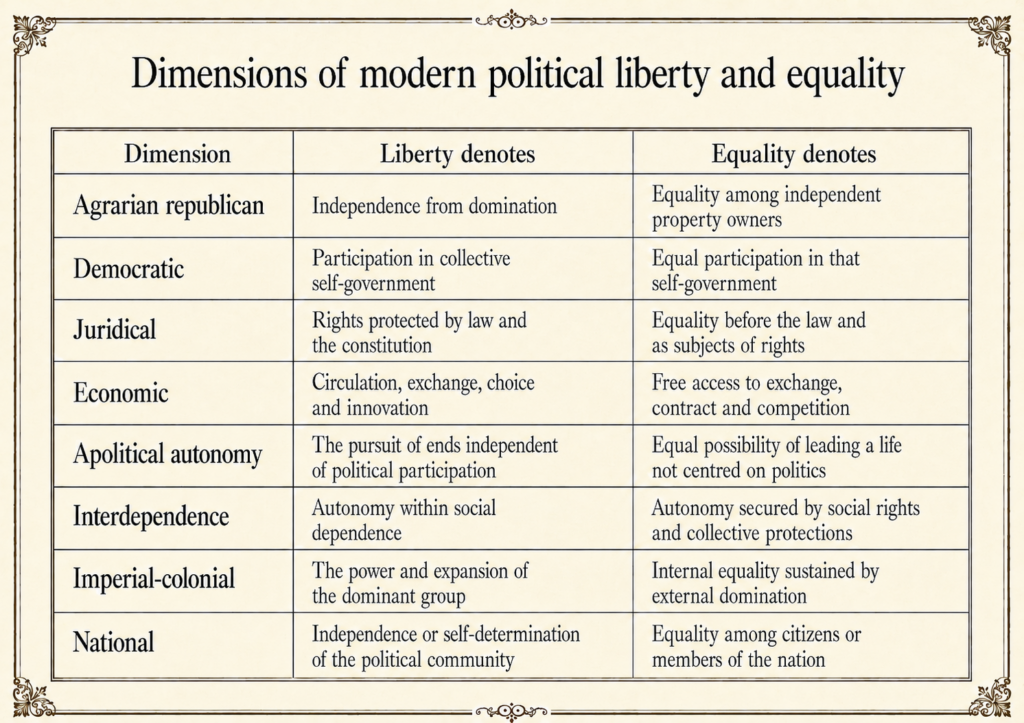
Eight Dimensions in Tension
| Dimension | Liberty denotes | Equality denotes | Economic and social foundations | Principal danger |
|---|---|---|---|---|
| Agrarian republican | Independence from domination | Equality among heads of household or independent property owners | Land, virtue, property, arms, self-sufficiency | Exclusion of dependent persons: women, servants, wage earners, enslaved people and non-property-owners |
| Democratic | Participation in collective self-government | Equal participation in collective self-government | Equal citizenship, public deliberation, institutions | Exclusion from the demos; domination by the majority; a formal voice without real influence |
| Juridical | Rights defined and protected by law and the constitution | Equality before the law; equal recognition as legal subjects | Natural rights, civil law, constitution, checks and balances, contract, legal personality | Equality restricted to persons recognised by law; exclusion through legal categories |
| Economic | Movement, exchange, mobility, choice, innovation and technology | Equality understood as free access to exchange, contract and competition | Markets, commerce, finance, industry, infrastructure (energy, transport, communications…) | Abstract equality concealing unequal powers; dependence presented as voluntary exchange |
| Apolitical autonomy | The freedom to pursue ends that are not organised around participation in collective power | The equal legitimacy and effective possibility of leading a life that is not centred on political engagement | Family, social relations, work, leisure | Withdrawal leaves collective power to organised minorities; apparently apolitical activities conceal political power |
| Interdependence | Autonomy within social dependence | Equality guaranteed by social rights, security, labour protection and access to infrastructure | Wages, money, division of labour, public services, social rights, infrastructure | Concealed dependence, precariousness, anomie, depoliticised systemic power |
| Imperial-colonial | Collective power and expansion | Equality among members of the dominant political community, often sustained by external domination | Territorial appropriation, imperial trade, differentiated legal statuses among citizens, subjects and dominated populations | Internal equality founded on external inequality; racial or civilisational hierarchy; domination of external populations |
| National | Independence or self-determination of the political community | Equality among members of the political community, as citizens or nationals | Territory, state, citizenship, common institutions, language, shared history, army | Exclusion of foreigners or minorities from the circle of equals, subordination of individual liberties to national ambitions, transformation of self-determination into external domination |
The tensions that persist despite the universalisation of suffrage show that the different dimensions of liberty and equality identified throughout this article do not simply replace one another in succession. They overlap, reinforce one another or come into conflict. The agrarian republican dimension initially associates liberty with material independence and equality with a balance among property owners. It supports democratic participation, since those who depend upon no master appear better able to judge the common good. Yet it restricts the civic circle to those deemed independent and may encourage colonial expansion when, as in the United States, access to land rests upon the dispossession of Indigenous peoples.
The democratic dimension enlarges this circle by making participation in self-government an equal right. The juridical dimension complements it: it protects individuals against arbitrary power, recognises them as possessing the same legal personality and constrains power through the constitution. The history of suffrage nevertheless reveals a possible divergence between the two. A person may be protected by law without participating in its making; conversely, acquiring the vote guarantees neither effective influence nor the material means of exercising autonomy. Law may even institute exclusion when it divides individuals into active and passive citizens, free persons and slaves, or nationals and colonial subjects.
The economic dimension opens up other spheres of liberty. Commerce, contract, money, mobility, industry and innovation enable individuals to pursue a plurality of ends without submitting them directly to political power. They thus promote the apolitical autonomy emphasised by Constant: family, work, social relations, leisure and self-improvement acquire a legitimacy of their own. This autonomy is not opposed to political liberty, which guarantees it, but it may divert citizens from exercising that liberty. Constant already warned that absorption in private interests might lead the Moderns too readily to relinquish their share of collective power.
Economic liberty displays a comparable ambiguity. Open access to exchange, work and competition establishes an abstract equality among legally free actors. Yet this equivalence may conceal considerable asymmetries of power. Wage earners are in principle free to choose their employer, but depend upon the labour market; consumers choose among goods, but depend upon markets, supply chains and the monetary system. Voluntary exchange does not therefore abolish dependence: it makes it more mobile and impersonal.
The dimension of interdependence makes visible what the other dimensions capture only imperfectly. In industrial societies, autonomy is constructed within the division of labour and through collective institutions. Social rights, labour protection and public services do more than compensate for inequalities: they secure individual autonomy within relations of dependence. Durkheim nevertheless shows that the organic solidarity generated by the division of labour may become disordered or be imposed in a pathological form. Suffrage, law and checks and balances can organise interdependence, but they often remain centred upon the individual citizen, whereas economic dependencies are systemic and transnational.
The national dimension partly addresses this discrepancy by transforming interdependence into a capacity for collective action. It mobilises territory, resources, infrastructure, industry and the armed forces in the service of national independence and sovereignty. It may thereby strengthen the republic against external domination and support a certain equality among members of the political community. Yet it also risks restricting the circle of equals to nationals alone, or to a group regarded as fully representative of the nation, while simultaneously stigmatising other groups or designating them as enemies of the nation. The imperial-colonial dimension follows a different logic: it associates the liberty, equality and power of the dominant group with territorial expansion and the subordination of external populations or populations assigned an inferior political status. The two dimensions may combine when national unity rests upon colonial expansion and domination; they may also conflict, particularly when national movements struggle against an empire to secure their independence.
The analytical framework of political liberty and equality proposed here identifies ideal types – or dimensions – arising from several historical matrices: the political revolutions unfolding between 1688 and 1848; the philosophical currents accompanying them; the practices of self-government developed in the British colonies in America; the commercial, financial and industrial revolutions; and the extension of political and social citizenship. Through their complementarities and oppositions, these ideal types shed light upon both past and present. They are intended to facilitate the conceptualisation of political traditions and social habits, while revealing their tensions and blind spots in a world undergoing intense technological, political and environmental change.
Notes
1 Myriam-Isabelle Ducrocq, « James Harrington, critique dissident de la common law », Cercles : Revue Pluridisciplinaire du Monde Anglophone, 2012, vol. 24, p. 4-14.
2 Algernon Sidney, Discourses Concerning Government [1698], T.G. West (ed.), Indianapolis : Liberty Fund, 1996, p. 366 in Ibid.
3 https://www.parliament.uk/about/living-heritage/evolutionofparliament/originsofparliament/birthofparliament/overview/simondemontfort/
4 James Harrington, The Commonwealth of Oceana, Project Gutenberg, 2016 : “The former kind [ancient prudence] is that which Machiavel (whose books are neglected) is the only politician that has gone about to retrieve”.
5 Ibid : “if the whole people be landlords, or hold the lands so divided among them that no one man, or number of men, within the compass of the few or aristocracy, overbalance them, the empire (without the interposition of force) is a commonwealth.”
6 https://damiengimenez.fr/wpdgi_article_en/interests-as-the-driving-forces-of-social-recomposition-in-eighteenth-century-great-britain/#Court_vs_Country
7 https://www.britannica.com/biography/James-Harrington
8 Gordon S. Wood, The Creation of the American Republic, Norton, 1972, p. 100 sq.
9 Museum of the American Revolution, “Decision-Making and Civic Engagement in Revolutionary America”, Museum of the American Revolution, n. d. ; Alan Taylor, American Colonies: The Settling of North America, Penguin, 2001.
10 Pauline Maier, From Resistance to Revolution: Colonial Radicals and the Development of American Opposition to Britain, 1765–1776, W. W. Norton, 1972.
11 Alexander Keyssar, The Right to Vote: The Contested History of Democracy in the United States, Basic Books, 2000 ; Ed Crews, “Voting in Early America”, Colonial Williamsburg, 2007.
12 Alan Taylor, op. cit. ; Daniel K. Richter, Facing East from Indian Country: A Native History of Early America, Harvard University Press, 2001.
13 John Locke, Two Treatises of Government, §4 in The Works of John Locke in Nine Volumes, vol. 4: Economic Writings and Two Treatises of Government, London, Rivington, 1824 (12th ed.), Online Library of Liberty, Liberty Fund.
14 Ibid., §6.
15 Ibid.
16 Ibid., §87.
17 Ibid.
18 Ibid., §57.
19 Ibid., §94.
20 Ibid., §§105–112.
21 Montesquieu, L’esprit des lois, XI, III, Flammarion, 1979 : « La liberté est le droit de faire tout ce que les lois permettent ».
22 Ibid., XI, IV.
23 Gordon S. Wood, The Creation of the American Republic, 1776-1787, Norton, 1972, p. 8, 29, 119, 153, 160.
24 Ibid., p. 100 sq. ; Gordon S. Wood, The Radicalism of the American Revolution, Vintage Books, 1993, chap. 9 : “No English ruler, no English master, and certainly no superior among the American colonists—who were more English than the English themselves—ever had it easy. Liberty, insubordination, and unwillingness to truckle to any authority were what distinguished Englishmen from Frenchmen and all the other enslaved and deprived peoples of the world.”
25 Robert Middlekauff, The Glorious Cause, Oxford University Press, 2005 (1982), chap. 6.
26 John Locke, op. cit., §123-124 and 134.
27 Ibid., §27.
28 Ibid., §134.
29 Ibid., §85.
30 Robert Middlekauff, op. cit.
31 John Adams and James Otis, cited by Bernard Bailyn in The Ideological Origins of the American Revolution, The Belknap Press of Harvard University Press, 1992 (1967), p. 69.
32 Robert Middlekauff, op. cit., chap. 14.
33 https://www.archives.gov/founding-docs/declaration-transcript
34 Robespierre, Discours du 8 thermidor, an II delivered at the Convention : https://fr.wikisource.org/wiki/Discours_du_8_thermidor_an_II_%28Robespierre%29
35 Olympe de Gouges’s Declaration of the Rights of Woman and of the Female Citizen confirms that this ambiguity was already apparent in 1791.
36 https://www.conseil-constitutionnel.fr/le-bloc-de-constitutionnalite/declaration-des-droits-de-l-homme-et-du-citoyen-de-1789 : « Les représentants du peuple français, constitués en Assemblée nationale, considérant que l’ignorance, l’oubli ou le mépris des droits de l’homme sont les seules causes des malheurs publics et de la corruption des gouvernements, ont résolu d’exposer, dans une déclaration solennelle, les droits naturels, inaliénables et sacrés de l’homme, afin que cette déclaration, constamment présente à tous les membres du corps social, leur rappelle sans cesse leurs droits et leurs devoirs ».
37 Bernard Manin, Un voile sur la liberté, Hermann, 2025.
38 Ibid.
39 Mona Ozouf, L’Homme régénéré. Essais sur la Révolution française, Gallimard, 1989.
40 Robespierre, Sur les principes de morale politique qui doivent guider la Convention nationale dans l’administration intérieure de la République, discours prononcé le 17 pluviôse an II – 5 février 1794.
41 https://damiengimenez.fr/wpdgi_article_en/how-interests-and-values-rose-and-virtue-declined-16th-18th-centuries/#Montesquieu_When_the_Play_of_Interests_Devalues_Virtue
42 Robespierre, op. cit.
43 Ibid.
44 Montesquieu, L’esprit des lois, IV, V, Flammarion, 1979.
45 Ibid., XX, II : « si l’esprit de commerce unit les nations, il n’unit pas de même les particuliers. Nous voyons que, dans les pays où l’on n’est affecté que de l’esprit de commerce, on trafique de toutes les actions humaines, et de toutes les vertus morales : les plus petites choses, celles que l’humanité demande, s’y font, ou s’y donnent pour de l’argent. »
46 Céline Spector, « La vertu politique comme principe de la démocratie. Robespierre lecteur de Montesquieu », Michel Biard, Philippe Bourdin, Hervé Leuwers et Alain Tourret, Vertu et Politique. Les pratiques des législateurs (1789-2014), Presses universitaires de Rennes, p. 61-70, 2015.
47 Montesquieu, op. cit., XII, XIX.
48 Bernard Manin, op. cit.
49 Robespierre, op. cit.
50 Benjamin Constant, Des effets de la Terreur, 1796, URL : https://gallica.bnf.fr/ark:/12148/bpt6k6271091r/
51 Ibid. : « Sans doute, lorsqu’un juge condamne à la fois un innocent et un coupable, la terreur s’empare de l’âme de tous les coupables, comme de l’âme de tous les innocents. Mais la punition du coupable aurait rempli, de ce but, tout ce qui était nécessaire. »
52 Ibid.
53 Benjamin Constant, De la liberté des Anciens comparée à celle des Modernes, in Œuvres politiques, Charpentiers et Cie, Libraires-éditeurs, 1874, p. 258-286. URL : https://fr.wikisource.org/wiki/%C5%92uvres_politiques_(Constant)/De_la_libert%C3%A9_des_Anciens_compar%C3%A9e_%C3%A0_celle_des_Modernes
54 J. G. A. Pocock, The Machiavellian Moment, Princeton University Press, 1975 ; Eric Foner, Free Soil, Free Labor, Free Men, Oxford University Press, 1971.
55 Joseph Schumpeter, The Theory of Economic Development, 1934, translated from German by Redvers Opie, fellow of Magdalen College, Oxford.
56 Karl Marx, Le Capital I, Gallimard, 2020, p. 263-264.
57 Georg Simmel, Philosophie de l’argent, Presses universitaires de France, 2014.
58 Émile Durkheim, De la division du travail social, Presses universitaires de France, 2017.
59 Robert Castel, Les Métamorphoses de la question sociale. Une chronique du salariat, Fayard, 1995 ; T. H. Marshall, Citizenship and Social Class and Other Essays, Cambridge University Press, 1950.
60 Pierre Rosanvallon, Le Sacre du citoyen. Histoire du suffrage universel en France, Gallimard, 1992 ; Alessandro Lizzeri et Nicola Persico, « Why Did the Elites Extend the Suffrage? Democracy and the Scope of Government, with an Application to Britain’s “Age of Reform” », The Quarterly Journal of Economics, MIT Press, 2004 ; Humberto Llavador et Robert J. Oxoby, « Partisan Competition, Growth, and the Franchise », The Quarterly Journal of Economics, MIT Press, 2005 ; Stanley L. Engerman et Kenneth L. Sokoloff, « The Evolution of Suffrage Institutions in the New World », The Journal of Economic History, Cambridge University Press, 2005 ; Luis R. Fraga, « Vote Dilution and Voter Disenfranchisement in United States History », Notre Dame Journal of Law, Ethics & Public Policy, University of Notre Dame Law School, 2022.
61 Pierre Rosanvallon, op. cit. ; Alessandro Lizzeri et Nicola Persico, op. cit. ; Humberto Llavador et Robert J. Oxoby, op. cit.
62 Stanley L. Engerman et Kenneth L. Sokoloff, op. cit. ; Luis R. Fraga, op. cit. ; Manisha Sinha, The Rise and Fall of the Second American Republic, Liveright Publishing Corporation, 2024.
63 Daron Acemoglu et James A. Robinson, « Why Did the West Extend the Franchise? Democracy, Inequality, and Growth in Historical Perspective », The Quarterly Journal of Economics, MIT Press, 2000.
64 Alessandro Lizzeri et Nicola Persico, op. cit. ; Humberto Llavador et Robert J. Oxoby, op. cit.
65 Stanley L. Engerman et Kenneth L. Sokoloff, op. cit.