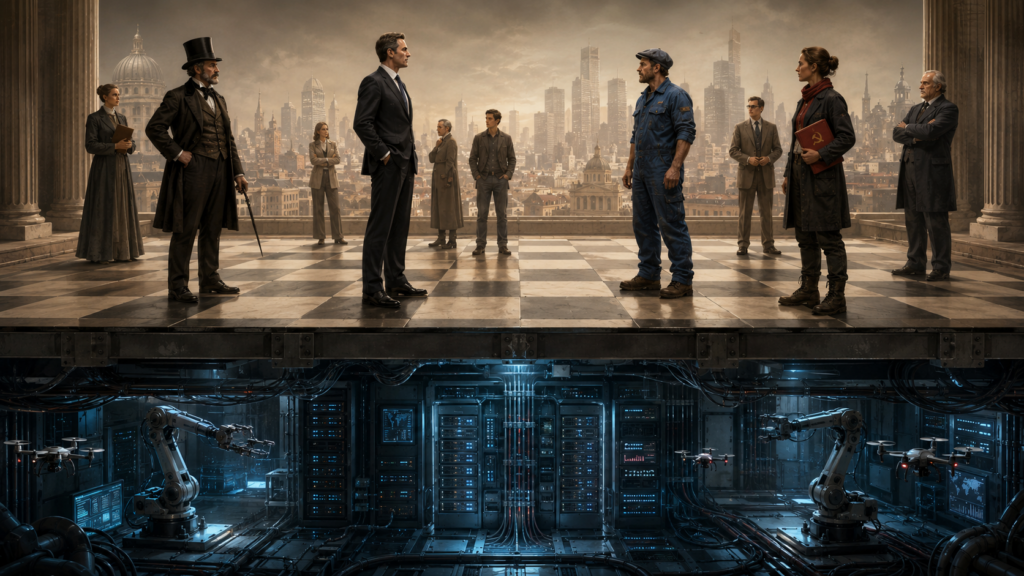
A host of emotions can crowd in today at the sight of contemporary political and geopolitical theatres: indignation and anger, stoked by proliferating violence and injustice; anxiety generated by technological revolutions and the unpredictability of actors; sadness caused by party fragmentation and national discord; joy sparked by fleeting victories; weariness sustained by the reproduction of backward-looking forms of authoritarianism, and so on.
For millennia, philosophers have stressed how much emotions or passions can blind us and lead us astray. Contemporary psychology and social psychology extend this type of analysis by highlighting biases or bringing collective drifts to light, especially on social media. Despite advances in knowledge, it still appears difficult to gain distance from what unsettles us, and also from what we take for granted. This is one reason why political analyses rarely command unanimous agreement.
The analytical framework I propose here seeks to take emotional dynamics into account. It is divided into three axes: political and socio-economic ideologies; idealisations of collective concepts, values, or historical configurations; business power embodied by successful leaders. To these three axes, which are explicit in the discourse of the actors, must be added one presupposition: the valorisation of the economy, which forms the backdrop to contemporary political chessboards and is rarely called into question.
Ideologies
Ideologies correspond to explicit or semi-explicit doctrines, for example liberalism, neoliberalism, Marxism, socialism, nationalism, and so on. Each of these doctrines is associated with one or more theories that provide a logic, a vocabulary, concepts, and political programmes. These theories may be more or less elaborate and institutionalised.
Several intellectuals – Daniel Bell, Raymond Aron, Jean-François Lyotard, Francis Fukuyama, Anthony Giddens, and others – announced, diagnosed, or accompanied, in different ways, the exhaustion of the great ideological confrontations. They associated the concept of ideology in particular with Marxism and capitalism, and anticipated, with the end of communism, the end of ideologies, or rather the acceptance of ideologies – liberalism, capitalism – that would no longer encounter major opposition. Debates would then concern the pragmatic implementation of policies and techniques of governance within democracies sustained by shared prosperity.
Contemporary political and economic controversies, however, reveal the vitality of these supposedly moribund ideologies. If Marxism is not rising from the ashes, increasingly diverse oppositions to neoliberalism and capitalism are animating debate.
Idealisations
Whereas ideologies are supported by a theoretical logic that defines a coherent whole and aims at a form of social organisation, idealisations are not, strictly speaking, doctrines; they belong to the symbolic realm: laden with images and emotions to which people are attached, they cement a collective identity and frequently define one or more adversaries associated with it. They may correspond to:
- a collective concept: the nation, the people, civilisation, the Republic, the West, and so on;
- values: freedom, emancipation, sovereignty, progress, order, and so on;
- a historical configuration: revolution, a golden age, empire, and so on.
Ideologies, of course, are not impervious to idealisations: they most often rest on idealisations that constitute theoretical presuppositions or postulates, sometimes implicit ones.
For example, liberalism idealises universal values, constitutional democracy, the open society, or rational progress; nationalism idealises the people, the homeland, sovereignty, or a golden age; Marxism idealises economic materialism, emancipation, and class consciousness; anti-liberal far-right movements may idealise community, civil order, or national rebirth.
Idealisations therefore cannot be reduced to ideologies: they infuse them and set emotional dynamics in motion.
Business Power
Business power differs from ideologies and idealisations because it is oriented by specifically economic interests, whereas ideologies and idealisations operate first of all at the level of political representations. It describes the logic of action of actors pursuing success in their business ventures, the recognition associated with it, a dominant position for their firms, or the appreciation of their assets.
This analytical category seems to me more appropriate than that of oligarchy, since the latter, which we inherit from Aristotle, originally designates people who take part in government.1 Yet the business leaders – Musk, Zuckerberg, Bezos, Thiel, and others – who seek to influence politics are, to a large extent, guided by their personal interests and by those of the companies they run, which does not prevent them from also being animated by ideologies and idealisations.
The notion of business power also makes it possible to explain the apparent ideological plasticity of these leaders: they may defend an ideology at a given moment – liberalism, nationalism – insofar as it serves their business interests.
The Backdrop
We can therefore distinguish here three dimensions for analysing contemporary political chessboards:
- Ideologies structure political discourse.
- Idealisations create affective bonds and antagonisms.
- Business power defines strategies dictated by economic interests.
The third dimension shows that some companies, through their size and the profits they generate, produce actors capable of helping to shape national policy. It does not, however, go so far as to bring out the extraordinary value attached to the economy by contemporary societies, which now forms the backdrop to political chessboards.2 When ideologies oppose one another – capitalism vs socialism, liberalism vs protectionism – they most often do so in a language that does not call into question the shared pursuit of economic prosperity. Yet that pursuit runs up against technological upheavals, international competition, and environmental limits. This is why that backdrop appears to me to form the underlying fabric of political dissension – a fabric that has so far remained within the realm of tacit assumptions.
Notes
1 Cf. https://damiengimenez.fr/wpdgi_article_en/from-antiquity-to-the-dawn-of-modern-revolutions-did-commerce-foster-equality/
2 On this subject, see my series of articles on the valorisation of the economy and my series on the relationship between democracy and the economy.