In brief
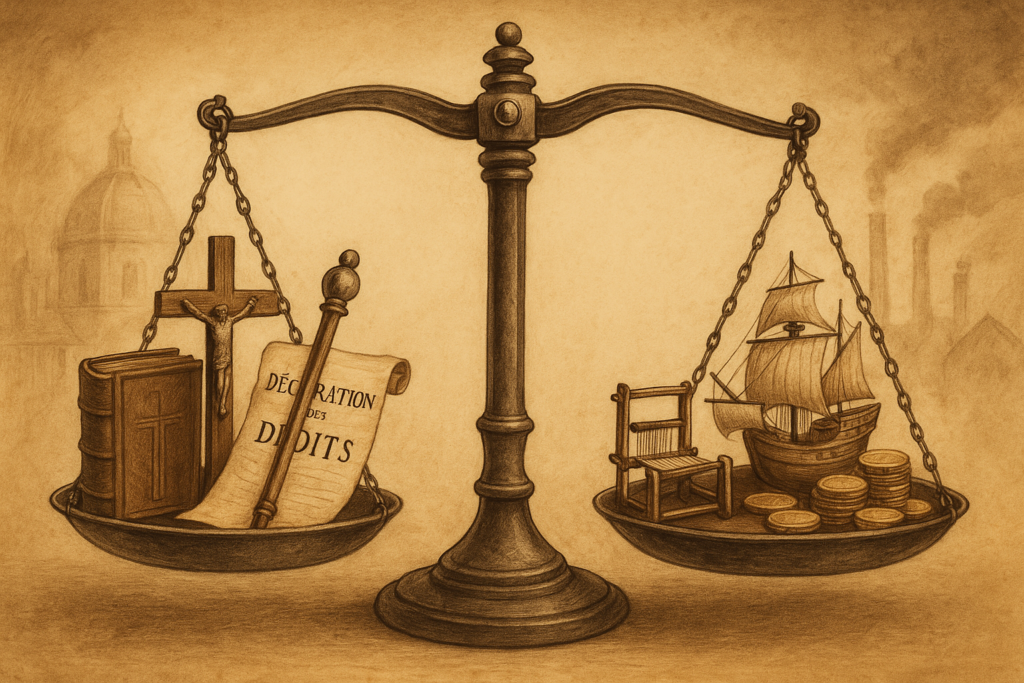
This series of articles traces how the economy, morally disqualified in the Middle Ages, has been socially and politically valorised since the 15th century.
Historical and conceptual itinerary: the Italian Renaissance, the Spanish and Dutch empires, 17th-18th-century England, and 19th-century philosophies.
In a world where sustained growth is no longer a given, understanding how the economy established itself as a social and political principle helps us grasp the present and envisage the future.
The pre-eminence of the economy in contemporary societies has become commonplace: the commodification of most goods and services; advertisements that punctuate television programmes, are plastered across screens, films and series, and even on athletes; the stakes around purchasing power and social inequalities; work itself, increasingly rivalled by AI and robots; the associated international tensions, such as tariffs; the energy question… The economy sits at the heart of our lives.
The proliferation of critiques—of capitalist production, of the private appropriation of profits, of markets or of consumption—attests to this pre-eminence. Often, they help to entrench it rather than to call it into question. For however indispensable they are, such critiques keep our attention fixed on the economy: they almost always discuss ways of transforming it, and rarely how to gain distance from it. Karl Marx’s approach is exemplary in this respect: he sought to demonstrate a major contradiction of capitalism (the tendency of the rate of profit to fall) using concepts and methods of calculation forged by the classical economists—thus from within economics, which he regarded as the primary explanatory factor for social phenomena.1 Yet such a conception was far from self-evident before the nineteenth century, and it remains the subject of lively controversy.
By what paths did the economy rise to the status of organising principle, to the point of sometimes seeming to supplant religion and politics? Investigating the valorisation of the economy leads us to question the relationship between thought and reality: did material conditions dictate the course of historical processes? If not, which ideas acted as a springboard for the economy? Of course, celebrated analyses have already cleared part of this ground. Most have adopted a particular angle: the Protestant ethic in Max Weber;2 the rise of capitalism and its tensions with the state in Fernand Braudel;3 the genesis of liberalism and its social limits in Karl Polanyi;4 passions and interests at the source of the market in Albert Hirschman;5 the economic ideology as the “culmination of individualism” in Louis Dumont;6 or eighteenth-century England portrayed as a “polite and commercial people” in Paul Langford.7
Each of the foregoing angles offers a complementary light on events and ideas. However, adding theoretically non-neutral perspectives complicates the task of forming an overall view. One might expect that, by the 21st century, there would be a historical and philosophical synthesis of the valorisation of the economy; yet such a project does not appear to have been pursued as such—despite the existence of global histories of capitalism—perhaps because academic specialisation fragments perspectives. This seems regrettable in a world driven by the economy and confronted with the two greatest upheavals it has known since the eighteenth century: the accelerated automation of economic activity as a whole, and global warming. These two features of our time are revolutionary because they call into question the economy as it has been practised for more than two centuries.
The aim of this series of articles is to grasp how the economy was valorised from the fifteenth to the nineteenth centuries and, in doing so, to better understand a contemporary world undergoing radical and destabilising changes. Its sole aim is to better understand the world we live in—a world subject to radical and destabilising changes. For it is only through knowledge that distance can be cultivated. The goal is not to produce a full-dress historical and philosophical synthesis, nor to repeat what has already been admirably formulated and synthesised, but to sketch a perspective encompassing facts and ideas—by way of salient events or figures and, of course, a selection of concepts articulated with one another.
We will begin our historico-conceptual journey with the Italian Renaissance—of the city-states, of humanism and of Machiavelli—which appears as the cradle of economic dynamics and of philosophies that support them (in earlier periods, economic activity was widespread but rarely a primary source of social prestige or political legitimacy—a point I return to in the first article). We then set sail for 16th-17th century Spain and the United Provinces, where commercial horizons widen towards Asia, Africa, and the Americas, where financial instruments are modernised, and where the first economic theories begin to take shape. We will then turn to the singular trajectory of 17th-18th century England: its political upheavals, its economic dynamics, and the philosophies associated with them. Finally, we will examine utilitarianism and its critics, the way in which, in the 19th century, work was promoted as a republican pillar, and the still-pressing question of the distribution of wealth.
Contents
- When the Economy Becomes a Value: The Turning Point of the Italian Renaissance.
- The Age of Extractive and Commercial Empires: Spain and the Dutch Republic (16th–17th Century)
- Wealth as a Political Principle: England, 17th–18th Centuries
- Interests as the driving forces of social recomposition in eighteenth-century Great Britain
- Utility, Work, Distribution: a New Grammar of the Social (19th Century)
Notes
1.↑ The economy constitutes the infrastructure of society; ideas the superstructure.
2.↑ Weber, Max. The Protestant Ethic and the “Spirit” of Capitalism, trans. Peter Baehr & Gordon C. Wells. London: Penguin Classics, 2002.
3.↑ Braudel, Fernand. Civilization and Capitalism, 15th–18th Century. 3 vols., trans. Siân Reynolds. New York: Harper & Row / London: Collins, 1981–1984; paperback reissue, University of California Press, 1992.
4.↑ Karl Polanyi, The Great Transformation, Beacon Press, 2001 (1944).
5.↑ Hirschman, Albert O. The Passions and the Interests: Political Arguments for Capitalism before Its Triumph. Princeton: Princeton University Press, 1977 (Princeton Classics reissue, 2013/2018).
6.↑ Louis Dumont, Homo aequalis I, Gallimard, 1985, p. 75. English version: From Mandeville to Marx: The Genesis and Triumph of Economic Ideology. Chicago: University of Chicago Press, 1977.
7.↑ Paul Langford, A Polite and Commercial People: England 1727–1783, Clarendon Press, 1989